Culture of Care
Caring for our People. Caring for our Animals.
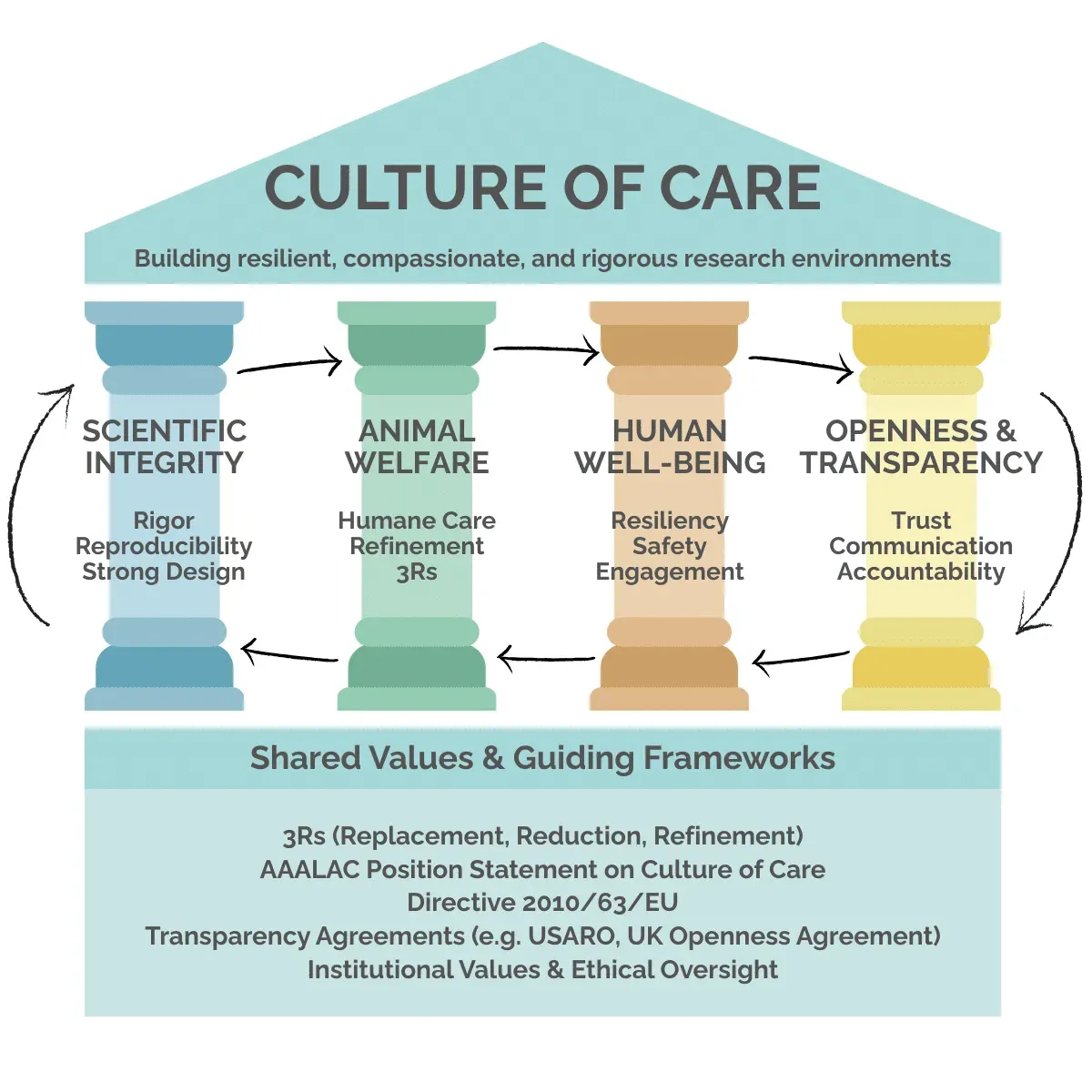
Culture of Care is a shared commitment to creating research environments where strong science, animal welfare, human well-being, and openness/communication are woven together.
This approach supports both scientific rigor and compassionate, responsible research, ensuring that animals, people, and science thrive.
The Four Pillars of Culture of Care
Scientific Integrity
Advancing strong, reproducible, and ethical science
Why It Matters:
Scientific rigor and reproducibility are the foundations of responsible animal research. Every procedure, model, and decision must be scientifically justified and thoughtfully designed to minimize unnecessary animal use and maximize meaningful outcomes.
Animal Welfare
Embedding the 3Rs (Replacement, Reduction, Refinement) into everyday practice
Why It Matters:
Commitment to animal welfare and the principles of Replacement, Reduction, and Refinement ensures that every use of animals is justified, humane, and continually improved. Animals in well-designed, welfare-conscious studies yield better, more reliable data.
Human Well-Being
Supporting personnel resilience, safety, and engagement
Why It Matters:
People are at the heart of the Culture of Care. A resilient, supported, and engaged workforce can recognize issues early, adapt effectively, and bring compassion and consistency to their work. Recognizing the emotional aspects of our work and creating a psychologically safe environment are essential to caregivers’ well-being and sustaining animal welfare and scientific excellence.
Openness and Transparency
Building trust through clear, honest communication within and outside the research community
Why It Matters:
Trust is built when institutions communicate clearly and honestly about their work. Openness fosters accountability, builds confidence with the public and stakeholders, and drives improvement through shared learning.
The Power of Integration
No single pillar can sustain a Culture of Care on its own.
- Strong science requires humane animal care, supported people, and clear communication.
- Animal welfare flourishes in an environment where people are engaged, research is rigorous, and transparency is valued.
- Human well-being is strengthened when people feel supported and can trust the systems they work within — systems that value welfare, integrity, and honesty.
- Openness and transparency are credible only when backed by high standards in science, welfare, and culture.
Together, these pillars form a coherent, resilient framework — one that supports both excellence in research and responsibility to animals, people, and society.
“A Culture of Care is not the sum of its parts — it is the strength of their connection.”
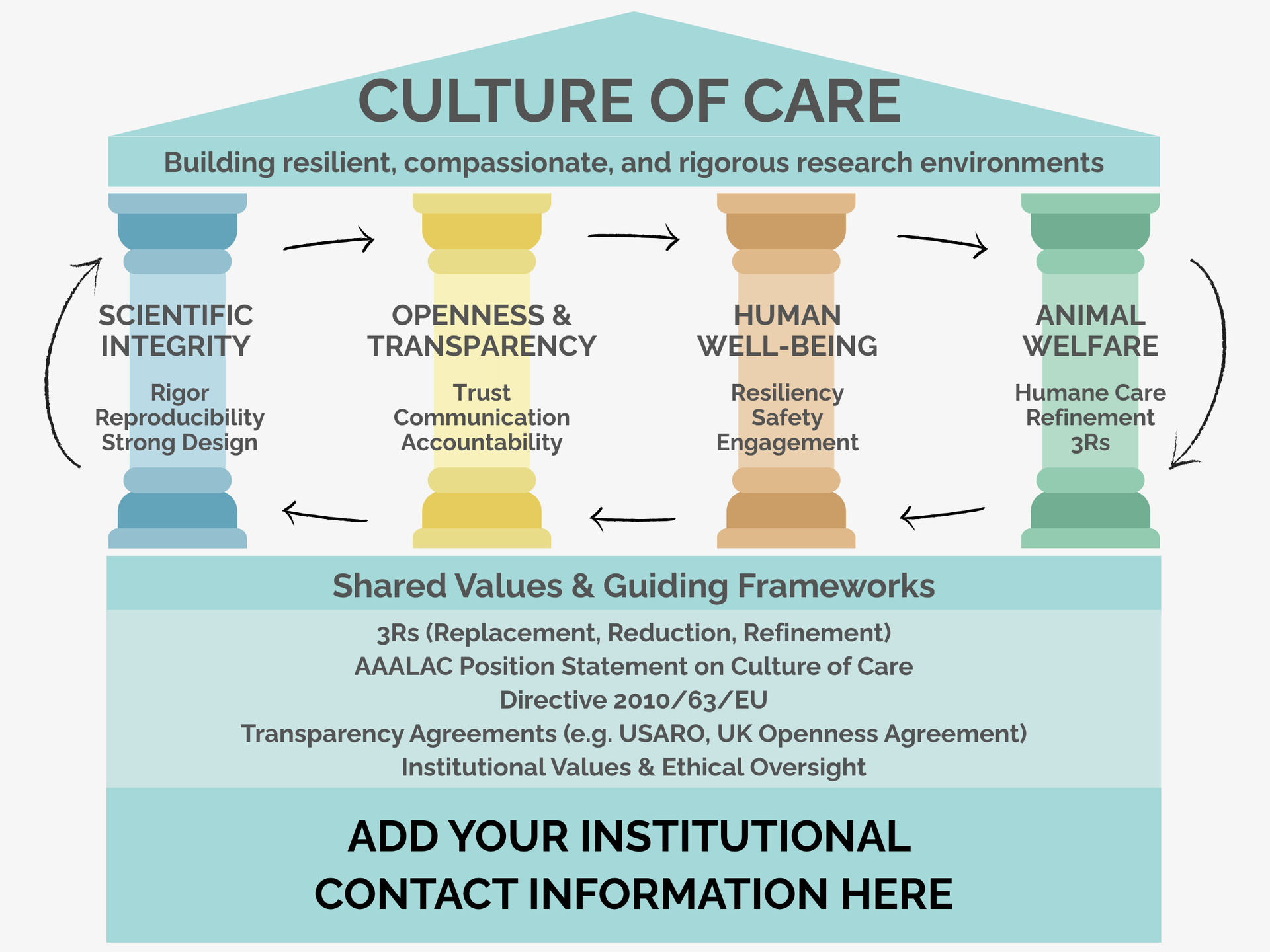
Editable Poster for Download
Want the Culture of Care pillars graphic to put in your facility or institution?
It is available to download in two sizes and editable to add your institution-specific resources or contacts:
11 x 8.5 in. poster | 24 x 18 in. poster
Also available in Spanish:
- New Zealand National Animal Ethics Advisory Committee. A Culture of Care – a guide for people working with animals in research, testing, and teaching.
- Herzog 2002. Ethical Aspects of Relationships Between Humans and Research Animals. ILAR Journal
- Klein & Bayne, 2007. Establishing a culture of care, conscience, and responsibility: addressing the improvement of scientific discovery and animal welfare through science-based performance standards. ILAR Journal
- Lloyd et al. 2008. Refinement: promoting the three Rs in practice. Laboratory Animals
- Hawkins 2017. Culture of Care Network Survey Report
- Brown et al. 2018. Culture of Care: Organizational Responsibilities. Management of Animal Care and Use Programs in Research, Education, and Testing. 2nd edition.
- Hawkins & Bertelsen 2019. 3Rs-Related and Objective Indicators to Help Assess the Culture of Care. Animals
- Robinson et al. 2019. The European Federation of the Pharmaceutical Industry and Associations’ Research and Animal Welfare Group: Assessing and benchmarking ‘Culture of Care’ in the context of using animals for scientific purpose. Lab Animal
- Williams 2021. Caring for those who care: towards a more expansive understanding of ‘cultures of care’ in laboratory animal facilities. Social & Cultural Geography
- Robinson et al. 2021. Improving culture of care through maximising learning from observations and events: Addressing what is at fault. Lab Animal
- Robinson & Kerton 2021. Contributing to Your Culture of Care. Animal Technology and Welfare
- Robinson & Kerton 2021. What does a Culture of Care look like? Lessons learntfrom a workshop survey. Lab Animal
- Bertelsen & Øvlisen 2021. Assessment of the Culture of Care working with laboratory animals by using a comprehensive survey tool. Laboratory Animals
- Valkenburg et al. 2021. Expanding Research Integrity: A Cultural-Practice Perspective. Science and Engineering Ethics
- Ferrara et al. 2022. Culture of care in animal research – Expanding the 3Rs to include people. Lab Animal
- Amarasekara et al. 2022. The Capability Maturity Model as a Measure of Culture of Care in Laboratory Animal Science. Alternatives to Laboratory Animals
- Robinson & Wilkinson 2022. Maintaining a Culture of Care during a research animal facility closure. Animal Technology and Welfare
- Tremoleda et al. 2023. New perspectives for teaching Culture of Care and their strengths and challenges. Lab Animal
- Abelson et al. 2023. Harmonisation of education, training and continuing professional development for laboratory animal caretakers, technicians and technologists: Report of the FELASA-EFAT Working Group. Laboratory Animals
- Turkménian et al. 2023. Scoring the Culture of Care as a key performance indicator in a global pharmaceutical company. Laboratory Animals
- Rumpel et al. 2023. Psychological stress and strain in laboratory animal professionals – a systematic review. Laboratory Animals
- De Peuter & Conix 2023. Fostering a research integrity culture: Actionable advice for institutions. Science and Public Policy
- Morahan et al. 2024. The culture of care to enhance laboratory animal personnel well-being: a scoping review. Lab Animal
- Ameli & Krämer 2024. Culture of care: the question of animal agency in laboratory animal science. Frontiers in Veterinary Science.
- Montanari et al. 2024. Animal Models in Neuroscience: What Is the “Culture of Care”? Encyclopedia
- von der Beck et al. 2024. What can laboratory animal facility managers do to improve the welfare of laboratory animals and laboratory animal facility staff? A German perspective. Animals
- Ameli & Krämer 2024. Transforming Culture: a Culture of Care in Animal Research. Society & Animals
- Gonzalez-Uarquin et al. 2025. Fostering culture of care for early career researchers – Building a trustful environment: Insights from a German perspective. PLoS One
- Ameli & Krämer 2025. Implementing Culture of Care in Germany. Animals
- Amarasekara et al. 2025. Assessment of the Culture of Care in Sri Lankan laboratory animal facilities and identifying challenges: A laboratory animal care staff-centered approach. Alternatives to Laboratory Animals
- Amarasekara et al. 2025. Building a Culture of Care in Laboratory Animal Science through practicing “remembrance”: A reflection on local practices in Sri Lanka. Animal Models and Experimental Medicine
- The Future is Now – Developing Your Institutional Culture of Care, AALAS National Meeting 2025
- The Heart of Research: Caring for Animals, Science, and People with Megan LaFollette, Swiss 3RCC Culture of Care Webinar Series
- Swiss 3RCC Culture of Care Webinar Series
- 3Rs Collaborative’s Culture of Care Resource
- RSPCA Guidance to Help Ethics Committees Promote a Culture of Care
- Norecopa – Culture of Care Summary
- RSPCA Culture of Care Resources
- University of Oxford Care-full Stories: Interactive Training Resources for Developing Your Institution’s Culture of Care
- UAR Oceania - Supporting Those Who Care for Research Animals: a guide for families and young people
- AAALAC's Culture of Care Position Statement
- Science talks for animal care teams – learning about the impact/outcomes of the science from the researcher teams, to better understand how daily animal care contributes to impact/outcomes
- Creating enrichment
- Garden maintenance – growing herbs for animals
How the Four Pillars Work Together
The Culture of Care is only strong when its four pillars — Scientific Integrity, Animal Welfare, Human Well-Being, and Openness & Transparency — are aligned and reinforcing one another.
Each pillar is essential on its own, but it is the interdependence between them that creates a truly resilient, compassionate, and effective research environment.
When these pillars are connected, they form a foundation that supports both excellent science and responsible stewardship.